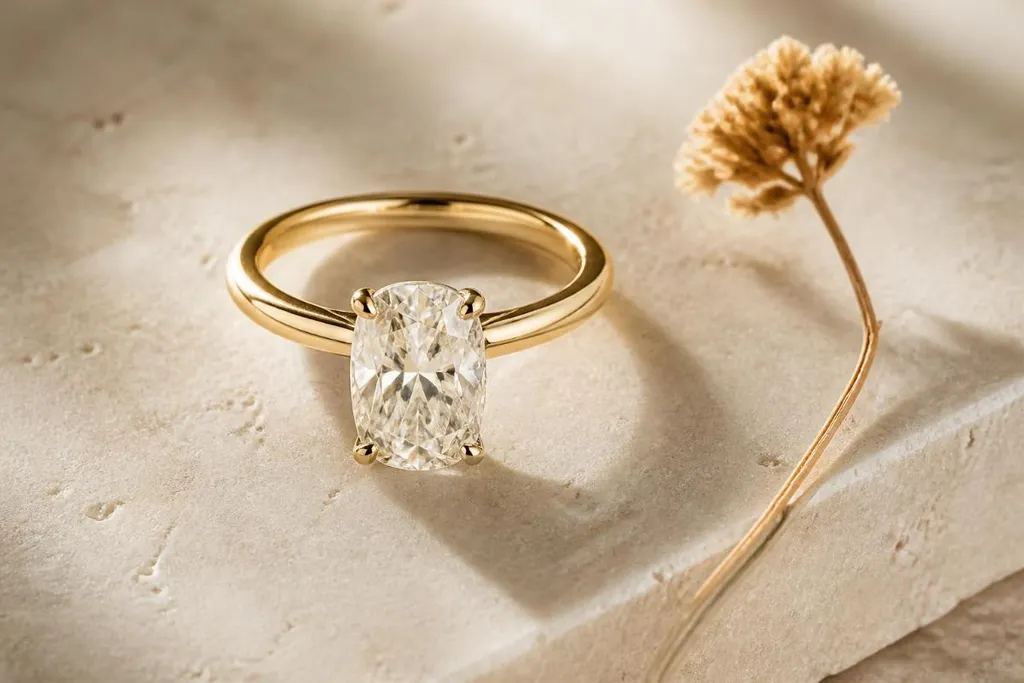
Some engagement rings feel contemporary because of elaborate detailing. Others achieve the same effect through proportion alone. An elongated cushion lab diamond belongs firmly in the latter category. Its softened corners retain the romantic character associated with traditional cushion cuts, while its extended silhouette creates a more modern line along the finger. Set on a petite 18k yellow gold band, the shape receives enough warmth and contrast to stand out without needing a halo or heavily embellished shoulders.
For someone drawn to this restrained combination, the option to order the yellow gold Lulu ring from Lily Arkwright demonstrates how an elongated cushion lab diamond can work with a delicate yellow gold solitaire setting. The appeal lies in proportion: a distinctive centre stone, minimal surrounding metalwork and a warm precious-metal colour that gives the design depth.
What Makes an Elongated Cushion Different?
A traditional cushion diamond is recognised by its softened square or rectangular outline and rounded corners. An elongated cushion extends those proportions, creating greater length from top to bottom while retaining the curved edges that distinguish the shape from sharper rectangular cuts.
That combination gives it an interesting balance. It has more structure than an oval but feels softer than a radiant or emerald cut. For someone who wants an elongated centre stone without pronounced corners, it can be particularly compelling.
Length-to-width ratio has a noticeable effect on character. A moderately elongated cushion may retain a substantial, almost pillowy appearance, while a longer ratio produces a slimmer and more contemporary silhouette.
Neither proportion is automatically superior. The wearer's finger shape, preferred stone size and desired overall aesthetic should guide the choice.
The solitaire setting makes these differences especially visible because nothing surrounds the diamond to disguise or modify its outline.
Why a Petite Setting Enhances the Centre Stone
A fine band changes the visual relationship between the diamond and the rest of the ring.
With less metal competing for attention, the elongated cushion can appear more prominent from above. This is particularly useful for someone who wants a substantial-looking centre stone but prefers the engagement ring itself to remain delicate.
Carat weight should still be considered alongside physical dimensions. A 2-carat elongated cushion may appeal because its additional size emphasises both length and softened geometry, giving the ring greater presence without requiring a halo. A smaller stone, however, can create a beautifully understated result that feels proportionate on a smaller hand or alongside other fine jewellery.
The setting should not simply be as thin as possible. A successful petite solitaire needs visual delicacy while still providing an appropriate structure for regular wear.
That balance between refinement and practicality is part of what makes a well-proportioned solitaire convincing.
The Warm Contrast of 18k Yellow Gold
Yellow gold gives an elongated cushion solitaire a different personality from the same diamond set in a white metal.
Rather than visually blending into the brightness of the stone, 18k yellow gold creates clear contrast. The diamond appears crisp against the warmer band, while the gold becomes a deliberate component of the design rather than disappearing into the setting.
This combination also bridges different jewellery traditions. Cushion shapes have historical associations, yellow gold is a longstanding fine-jewellery metal, and the elongated proportions bring both into a more contemporary context.
For someone who regularly wears yellow gold necklaces, earrings or bracelets, choosing the same metal can also make an engagement ring easier to integrate into an existing collection.
Over time, the polished surface will naturally show signs of wear. Gentle cleaning and occasional professional maintenance can help retain the desired finish, while periodic checks of the centre setting are sensible for any frequently worn engagement ring.
Building a Balanced Bridal Stack
A petite solitaire provides considerable flexibility when choosing a wedding band.
A plain 18k yellow gold band can reinforce the simplicity of the engagement ring and keep attention on the elongated cushion. A diamond-set wedding band adds sparkle without altering the clean outline of the solitaire itself.
Band width deserves careful thought. Pairing two similarly delicate rings can create a cohesive, understated stack, while a wider wedding band introduces stronger contrast.
Setting height is equally relevant. Depending on the construction beneath the centre diamond, a straight wedding band may sit flush against the engagement ring or leave a small gap. Neither effect is necessarily undesirable, but it is worth considering as part of the complete design rather than after the engagement ring has been chosen.
Final Thought
An elongated cushion lab diamond in a petite yellow gold solitaire succeeds through carefully controlled contrast. The centre stone combines soft corners with modern length, while the fine 18k yellow gold setting introduces warmth without overwhelming its shape.
For someone who wants an engagement ring that feels distinctive but not ornate, the combination offers an appealing middle ground. Its character comes from proportion and material rather than excess decoration—a quality that can help the design remain elegant long after individual trends have changed.